CODEX ASYA
₍^. .^₎⟆
₍^. .^₎⟆

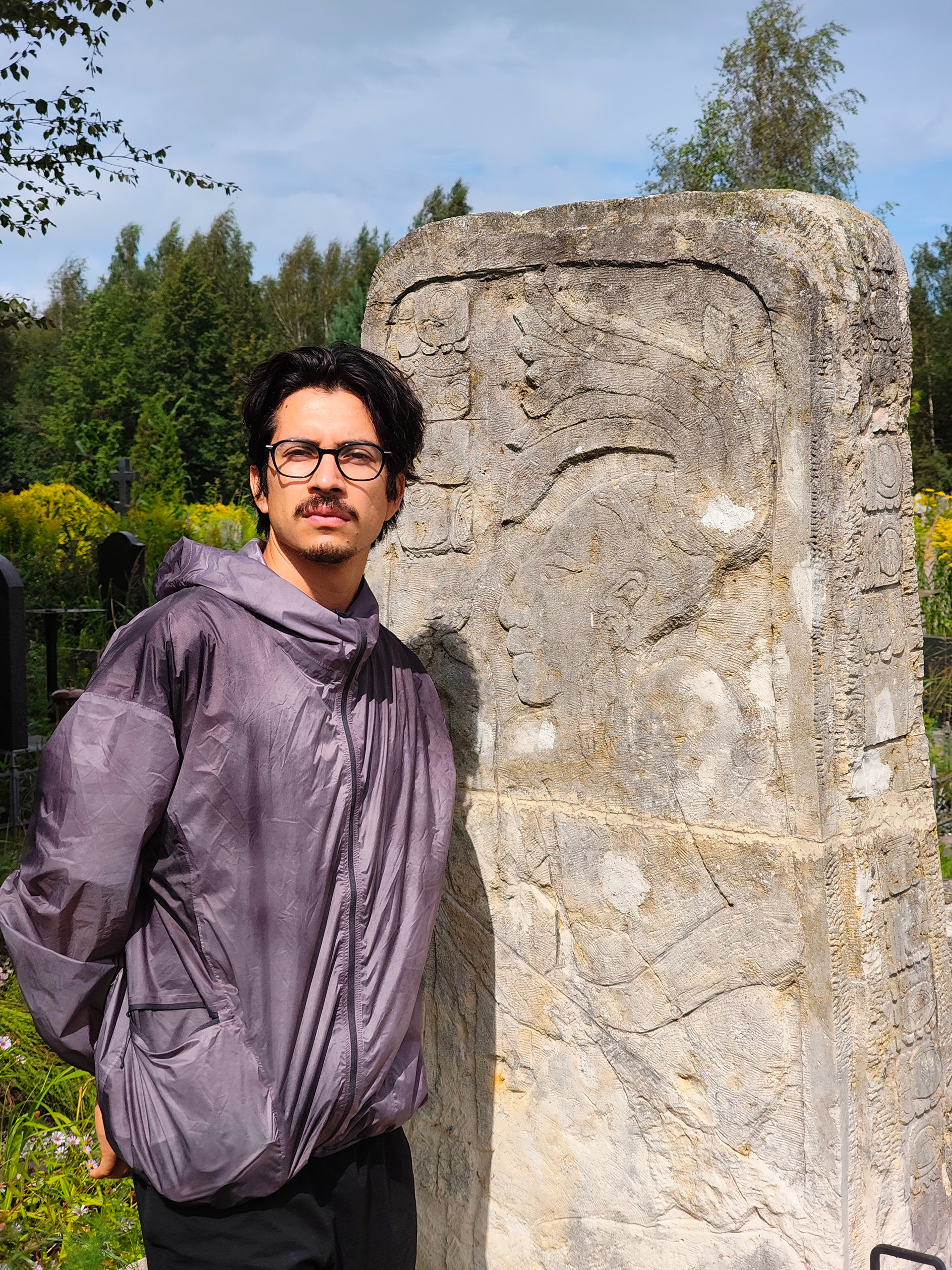
is a multidisciplinary installation and autonomous simulation functioning as a speculative “fifth Maya codex builder," narrated by Yuri Knórozov’s cat, using custom-trained AI to generate contemporary Maya glyphs materialized through robotic 3D clay printing.
The firs iteration will be present and commissioned by Gray Area X Modal exhibition, scaling intelligence. Oct 2026
https://grayarea.org/exhibitions/scaling-intelligence-modal-commissions/
https://grayarea.org/exhibitions/scaling-intelligence-modal-commissions/
The central figure is Asya, Yuri Knórozov’s cat, the Soviet linguist who deciphered the Maya script in 1952 working entirely from photographs, never having set foot in the region, working at a distance from the culture he was reading. She appears in nearly every image of him at work. In CODEX ASYA, she becomes a structural principle: a non-authoritative presence at the moment of decipherment, indifferent to its significance. The installation takes her as its narrator.
CODEX ASYA (Prototype Phase) develops and publicly tests a generative system that produces and materializes language through computation. This phase focuses on building a functional prototype integrating real time simulation, machine learning, and robotic fabrication into a single operational loop.
The system has three components. First: an Unreal Engine self-running simulation generates a continuously evolving environment. The simulation operates autonomously, producing non-linear sequences of landscapes, symbols, and transitions. Time is not fixed, the system loops, mutates, and reorganizes itself, functioning as a persistent computational environment rather than a narrative structure.
Second: a custom trained AI model produces new logograms derived from structural principles of Maya glyphs composition. Rather than reproducing existing glyphs, the model generates speculative symbols corresponding to contemporary concepts (algorithms, satellites, network systems), without claiming cultural authority or spiritual access. Outputs are continuously generated and filtered as part of the system’s internal logic.
Third: a robotic clay printing prototype translates selected glyphs into physical form. The printing process is visible and continuous, producing small scale objects that accumulate over time, a material record of the system’s activity, with a temporal offset between digital generation and physical output.
The work is built across dataset construction, model training, simulation design, and hardware prototyping. Demonstrations happen throughout, as people watch the system running, not as a finished work but as something still being worked out in real time.
Once the prototype phase wraps, the glyph dataset, model weights, and iteration logs get released openly, available for other artists and researchers to pick up and use.
Two questions stay unresolved across both phases: whether a logographic system can be extended without being appropriated, and whether an AI model can learn syntax without claiming meaning.